

Print engineering
Why a Good Blender Sculpt Can Still Make a Bad 3D Print
What the axolotl and Philippine eagle records show about geometry, scale, supports, and the boundary between digital checks and physical printing.
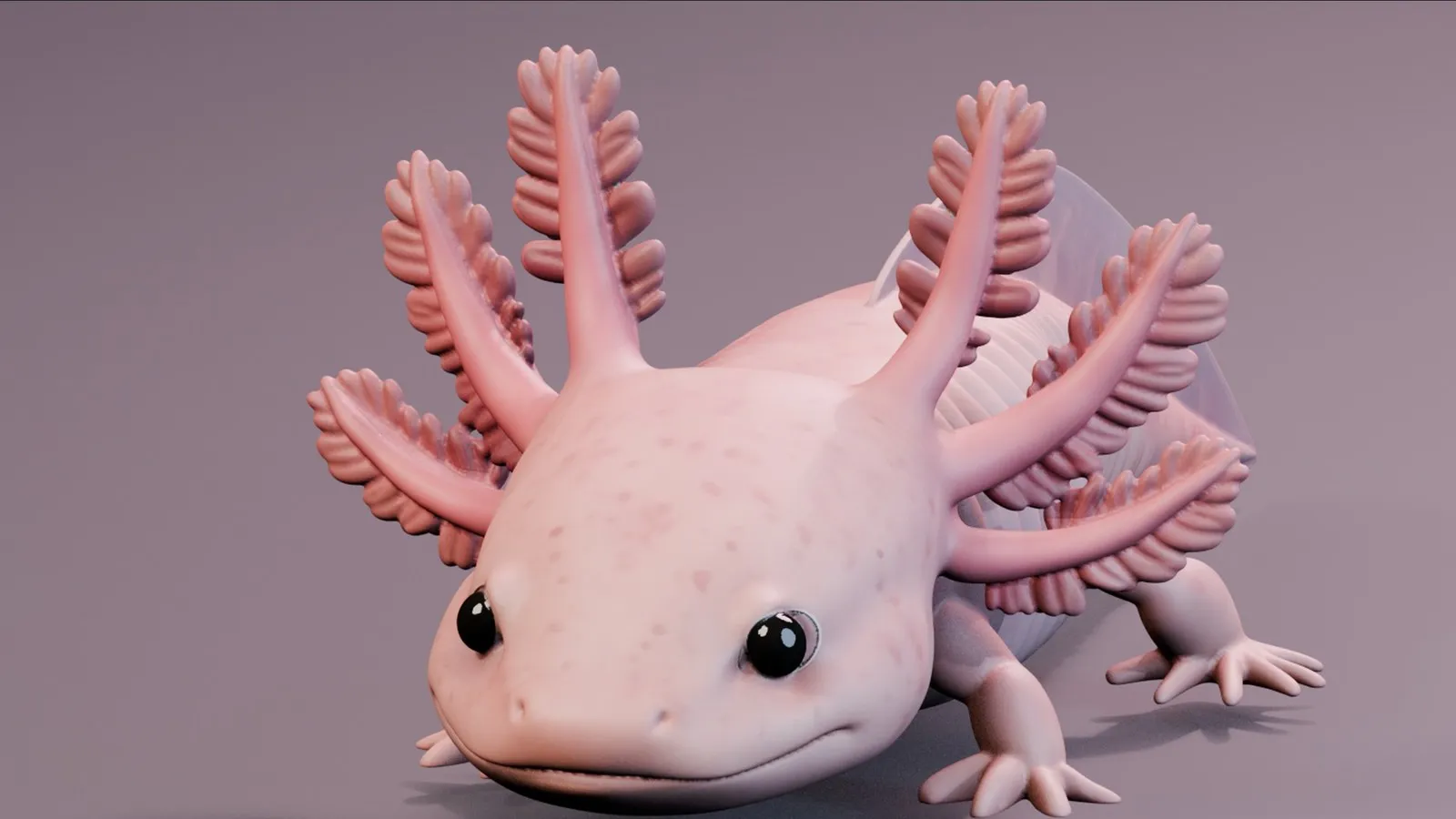
A render asks a different question than a print
The axolotl’s branching gills make its silhouette recognisable. They are also the feature singled out in its print guidance: remove supports carefully and handle the external filaments with care. The image can show their shape and colour convincingly without demonstrating that a printed filament survived removal.
That gap is the subject of this note. The axolotl and Philippine eagle models have specific dimensions, geometry views, support guidance, and digital checks. Neither has been physically test-printed by the seller. The available evidence explains the preparation limits; it does not document a failed print or a successful printer setup.
Delicate geometry remains delicate
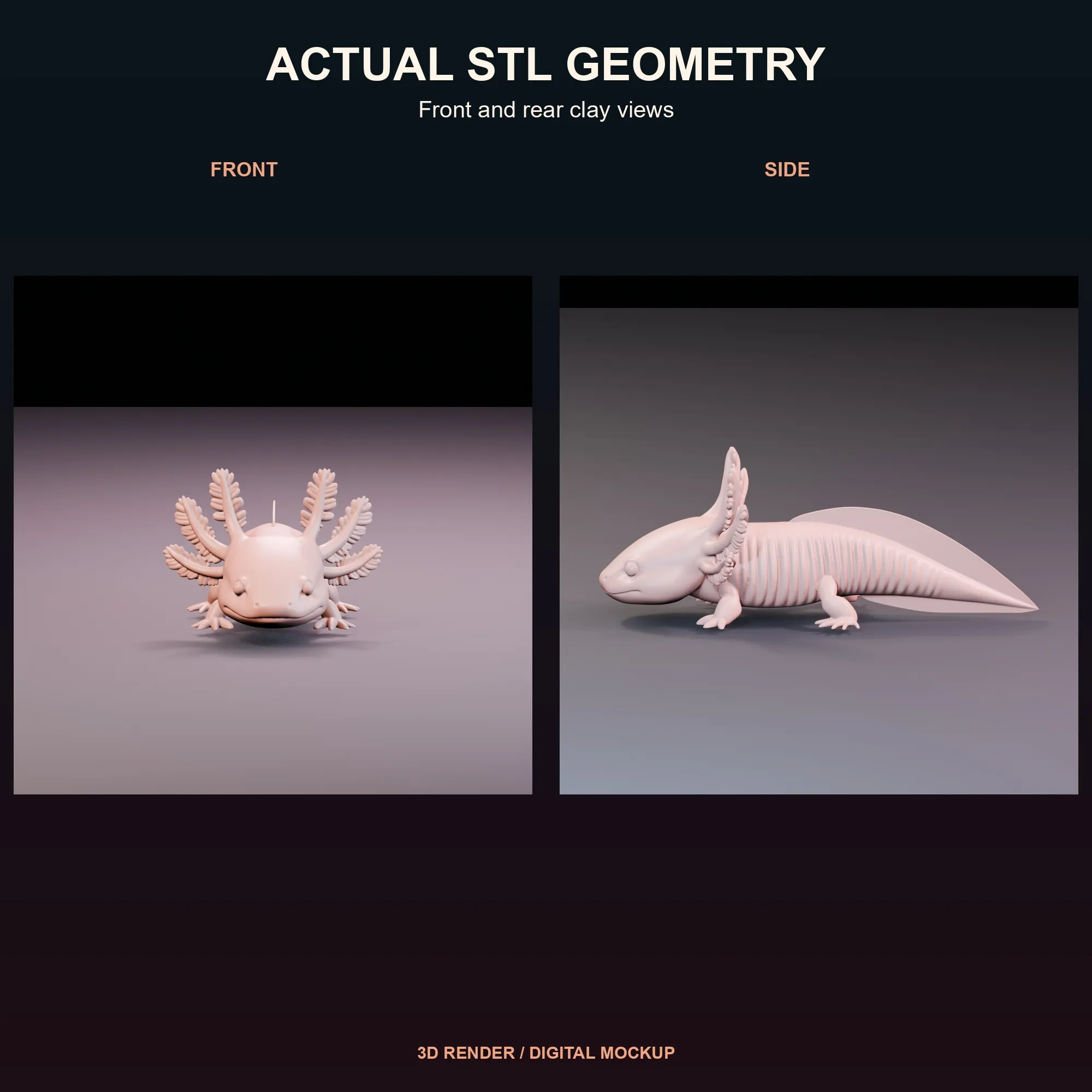
Digital clay views of the actual axolotl geometry. The plate’s subtitle says “front and rear”; the visible views and individual labels are front and side. No physical print is shown.
In the front view, the gills extend well beyond the axolotl’s broad head. The side view helps distinguish those branches from the tail and body. Switching from a coloured inspiration image to these untextured views removes one distraction: the STL contains geometry, not the pink surface finish shown in the hero.
The Philippine eagle has a different set of named handling constraints: crest and wing feather tips, beak edges, talons, tail feathers, and bark projections. The product guidance calls for care around those features during support removal. That is a more useful description than treating the entire sculpt as equally robust.
Size is part of the validation claim
The axolotl is published at 50.145 × 100 × 36.131 mm, in one part. Only the 100 mm maximum size has been digitally validated. Its guidance warns that smaller scales may lose strength or detail.
The eagle is published at 95.318 × 159.498 × 250 mm, also in one part. Its guidance says not to scale below the 250 mm longest dimension under the current release claim. These numbers describe the checked files. They do not establish a universal minimum printable size for either species, and there is no recorded smaller-scale test to supply one.
For a maker considering a reduced model, that is a practical stopping point: the existing check does not extend automatically to the new size. Keep the original dimensions available when comparing the model in a slicer.
Orientation is a decision, not a preset
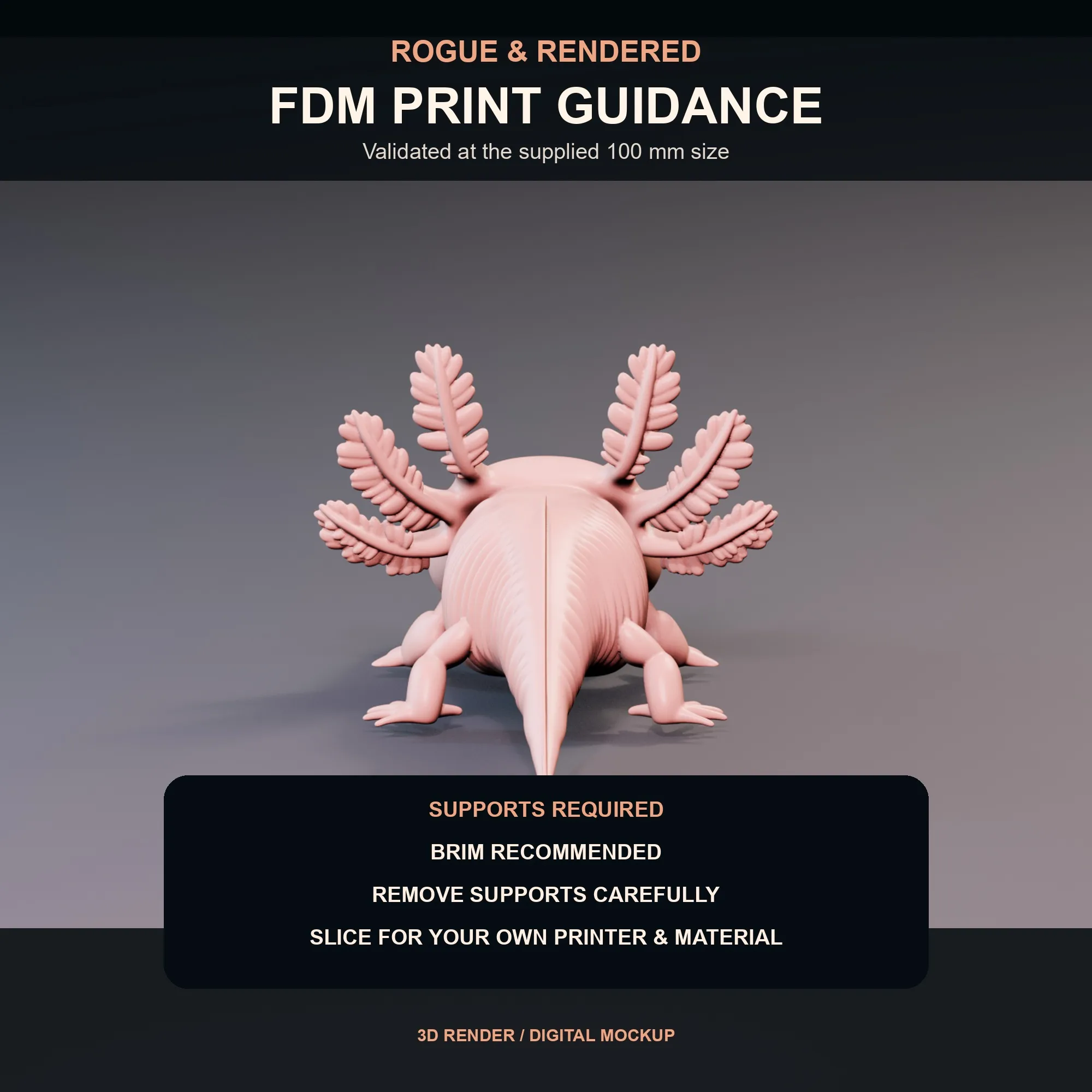
Owned project guidance. It does not prescribe one universal slicer profile.
The axolotl guidance requires supports and recommends a brim for stability. The eagle guidance says to use supports and a brim. Both ask the maker to slice for their own printer, material, scale, supports, and settings.
The graphic shows a view of the model and those instructions. It is not a screenshot of a completed support layout or proof of a particular orientation angle. No nozzle temperature, layer height, support density, or exposure setting has been recorded here. Choosing those values from the appearance of a render would introduce information the image cannot supply.
Digital validation is not a test print
Both models were digitally validated at their published dimensions. Neither has been physically test-printed by the seller. A render, geometry plate, or validation graphic therefore cannot be evidence of a printed object’s surface finish, support scars, strength, or successful handling.
The distinction also limits this article’s title. A visually convincing sculpt can still present printing difficulties, but these records do not document a specific failed physical print. The useful evidence is the stated handling constraint, checked size, and support guidance, together with what remains untested.
Start with the 3D printing FAQ, then inspect the Axolotl model or Philippine eagle model before choosing a setup.
Related notes
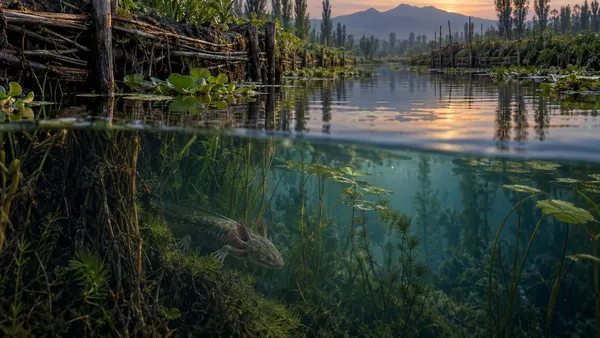
Visual research
Building an Axolotl Habitat Cross-Section Without Inventing the Evidence
A source-led account of how a Xochimilco canal habitat schematic was kept honest about what it shows.