Skip to content
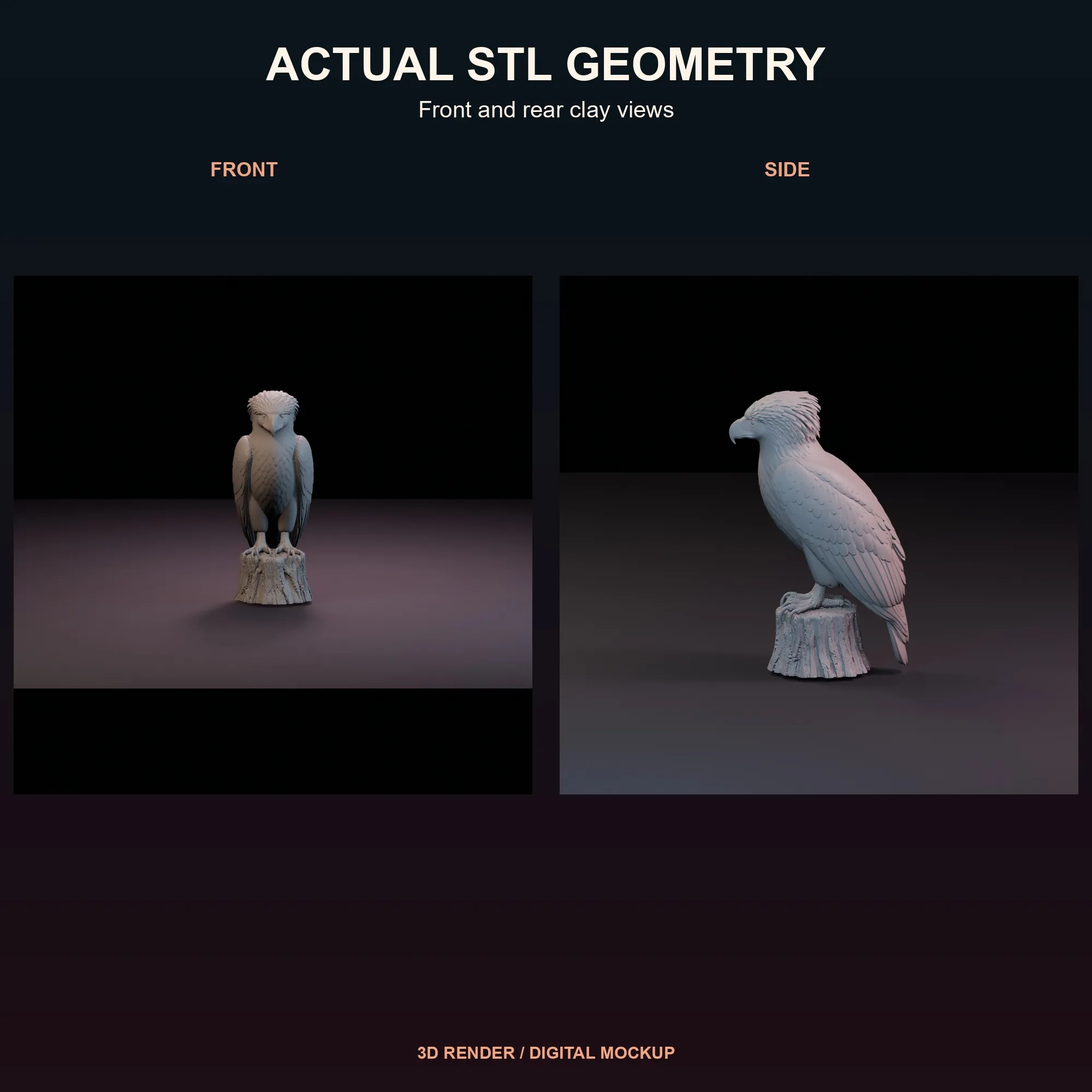
Digital render of an untextured Philippine eagle STL model perched on a short stump.3D render

3D render

Turntable view

A 12-second turntable of the Philippine eagle model. Rendered presentation media is for reference; texture and colour are not included in the STL.

Digital 3D model

Philippine Eagle

Pithecophaga jefferyi

A detailed Philippine eagle STL prepared for supported FDM printing at a 250 mm maximum dimension, with delicate feather, talon, and bark guidance.

See this model on Etsy

Digital model download. No physical item is shipped.

STL

Model and print details

Philippine Eagle model specifications
DetailWhat to know
Dimensions (X × Y × Z)95.318 × 159.498 × 250 mm
Included formatsSTL
Parts1
Digital validationCompleted at the published size.
Seller test printNo. Not physically test-printed by the seller.
Print setupUse supports and a brim. Slice the STL for your own printer, material, scale, supports, and settings.
Before you print
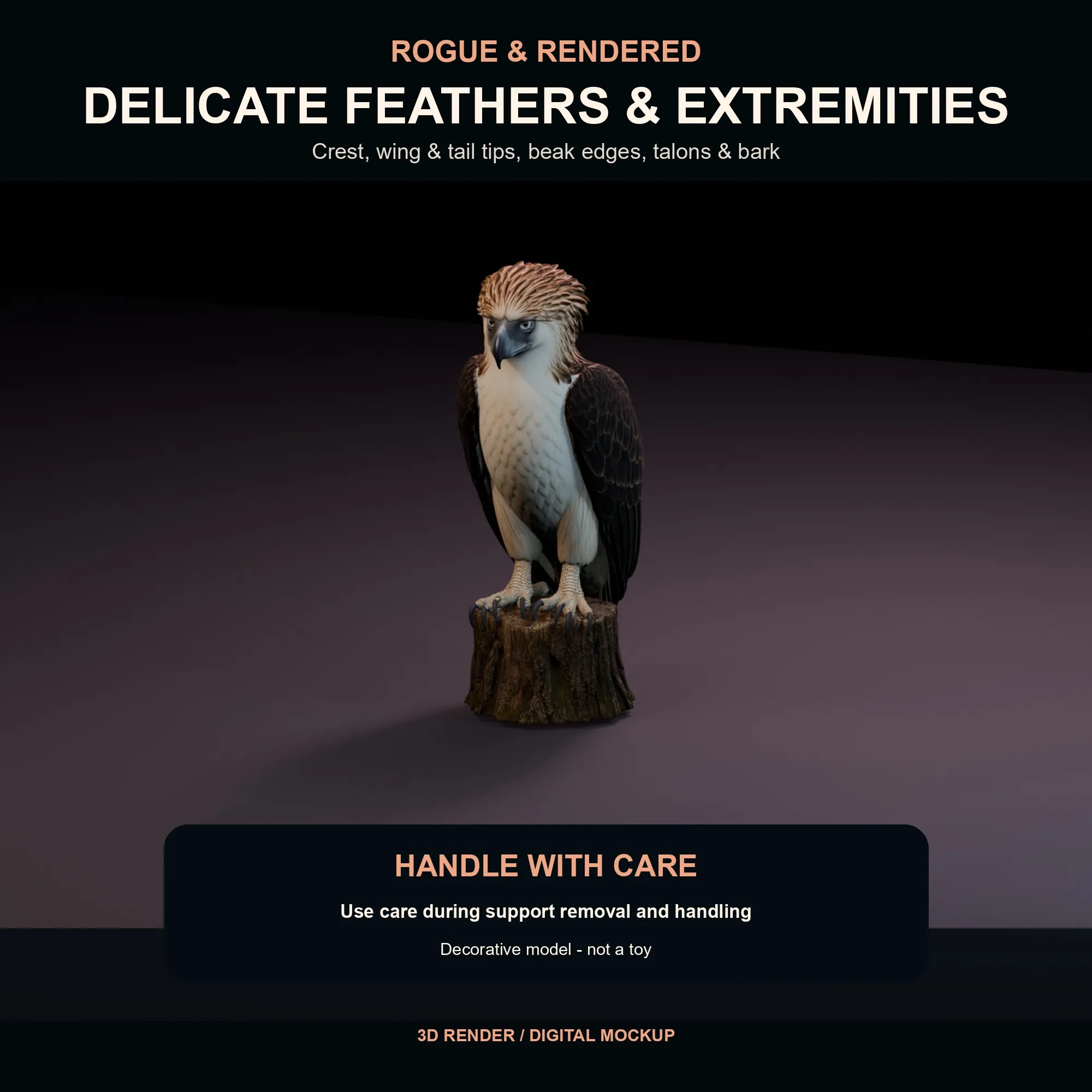
  • Crest and wing feather tips, beak edges, talons, tail feathers, and bark projections require careful support removal and handling.
  • Do not scale below 250 mm longest dimension under this release claim.
  • Results vary with printer, material, scale, supports, and slicer settings.

Your printer, material, scale, supports, and slicer settings can affect the result.

Read the personal-use licence


Larger view

Philippine Eagle image viewer

Literature-grade field guide · reviewed 2026-09-08

The living context behind the specimen

The Philippine eagle is a forest raptor built for vertical country: a deep wing, a powerful bill, and a crest that turns a silhouette into a declaration. Its future follows the fate of old-growth forest on the islands where it nests. A pair invests years in a breeding cycle, and a single nest tree sits inside a much larger territory of prey, canopy, rivers, and community care. To read this eagle well is to look past the dramatic profile toward the watershed that keeps the profile possible.

“A large eagle needs more than a nest tree; it needs a living forest around it.”

IUCN Red List statusCritically EndangeredCR · trend: decreasingRead the assessment
HomePhilippine forest landscapes
BreedingTypically one chick at a time
Primary pressureForest loss and persecution
Ecology at a glanceWhere a life fits
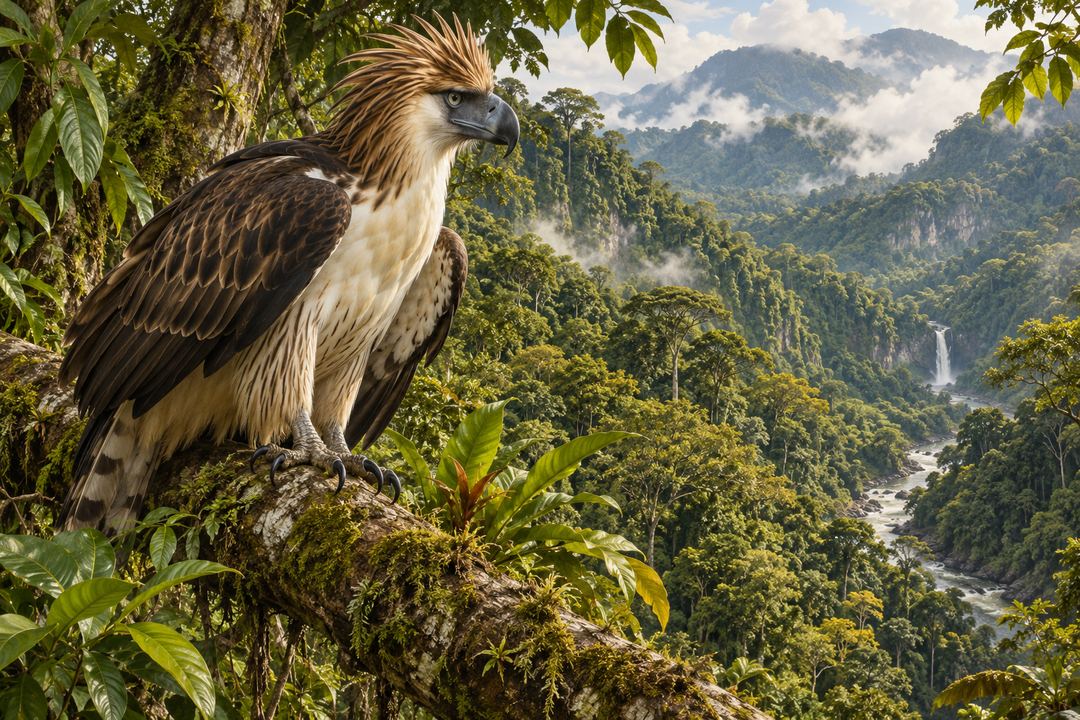
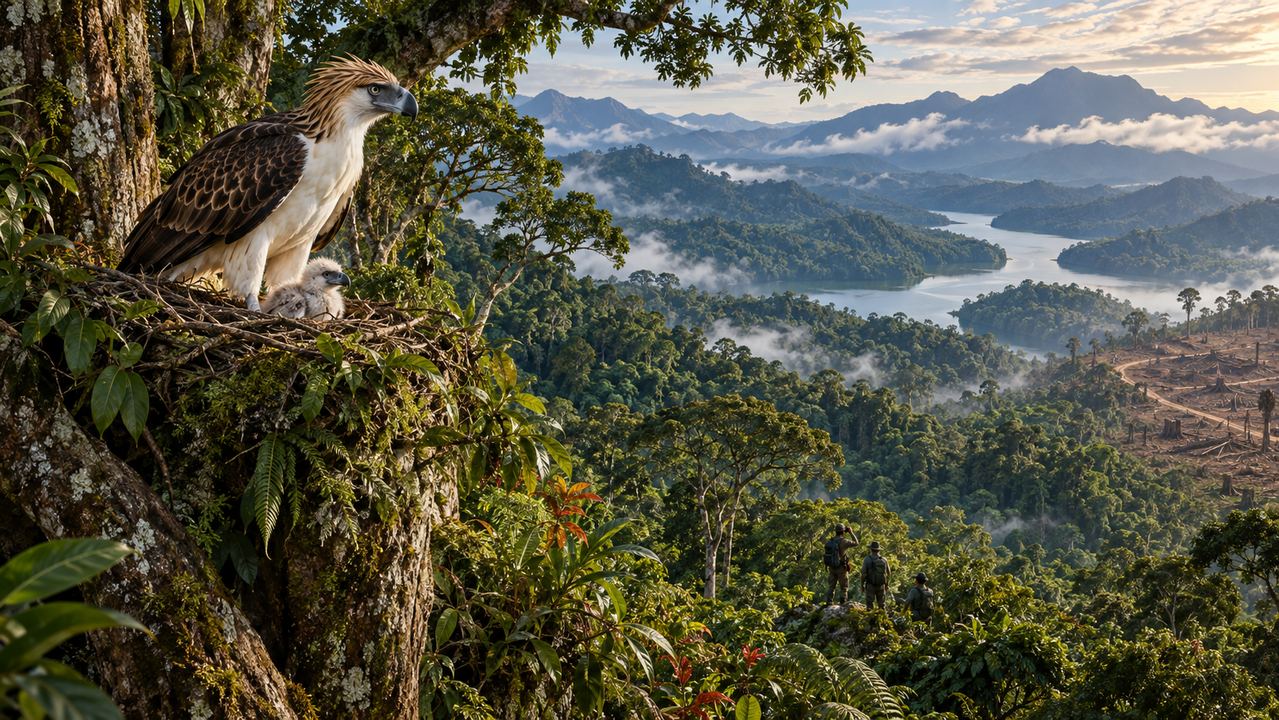
Interpretive Philippine rainforest scene with a Philippine eagle above a mature canopy and watershed.
FIG. 01VERTICAL FOREST SYSTEM

A nest tree is a vertical system

The eagle’s territory links canopy, watershed and the people who keep old forest standing.

CANOPY / NESTOld-growth nest treeHigh crown · breeding site
↓
FOREST / PREYHunting spaceConnected canopy and prey base
↓
WATERSHED / STEWARDSHIPLiving landscapeRivers, communities, protected forest

Conceptual vertical profile, not a surveyed elevation or range map. Source context: IUCN / Philippine Eagle Foundation.

A vertical forest diagram from canopy to watershed, linking a protected nest tree to community forest stewardship. Schematic, not to scale.

Conservation lensPressure → response
Interpretive conservation systems plate showing an old-growth nest tree, connected canopy, watershed, and community guardianship for the Philippine eagle.
FIG. 02PROTECTION PATHWAY

Protect the whole territory

Nest protection works when forest restoration and community stewardship travel with it.

PRESSUREForest lossFewer nest trees and prey-rich canopy
→
RESPONSEProtect nest + restore forestGuardianship, habitat protection, corridor care
→
RESULTBreeding space persistsRoom for pairs and a single chick
SHARED FOUNDATIONCommunity forest stewardship

Long-term protection makes the response durable.

Intended conservation logic, not a measured effect model or guarantee of recovery. Source context: IUCN / Philippine Eagle Foundation.

Life-history rhythmWhat the calendar changes
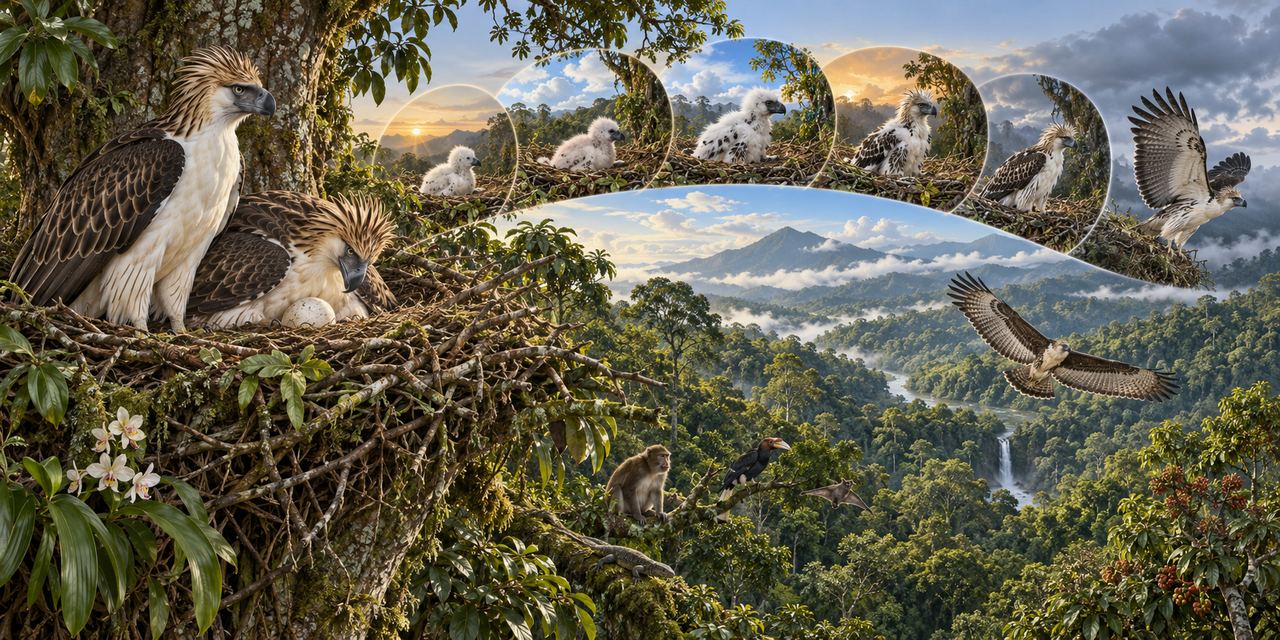
Interpretive Philippine eagle life-history plate showing a pair, nest care, a single developing chick, and an intact forest territory.
FIG. 03BREEDING CYCLE

One chick, many years of care

A slow breeding cycle makes each nest tree part of a much larger forest commitment.

  1. 01
    Nest tree

    A mature canopy anchors the breeding territory.

  2. 02
    Pair and chick

    One developing chick depends on sustained care.

  3. 03
    Forest territory

    Prey, rivers and connected cover keep the cycle viable.

Educational sequence, not a population chart or fixed calendar. Read the source-linked field notes.

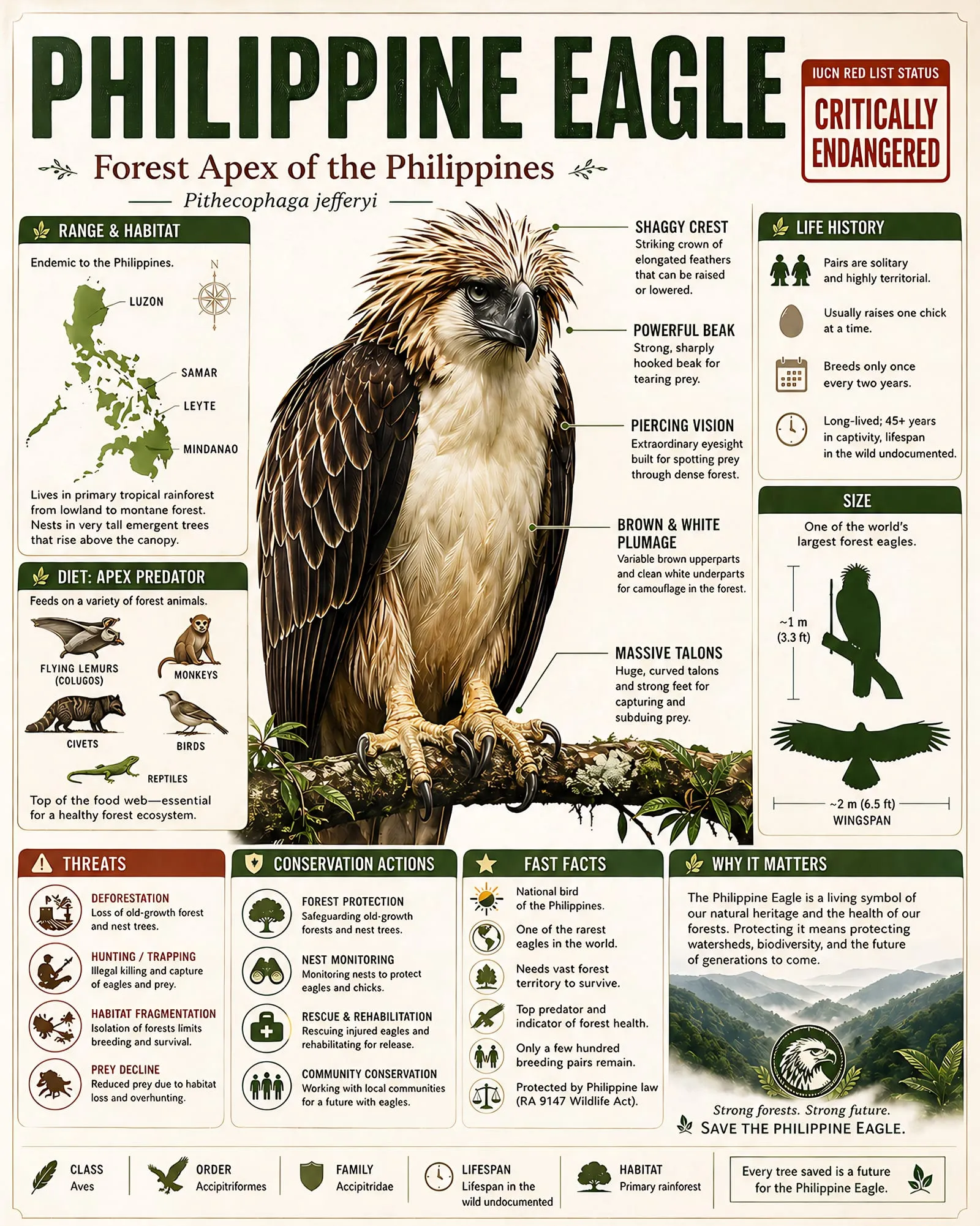
Morphology / study plateFeatures worth noticing
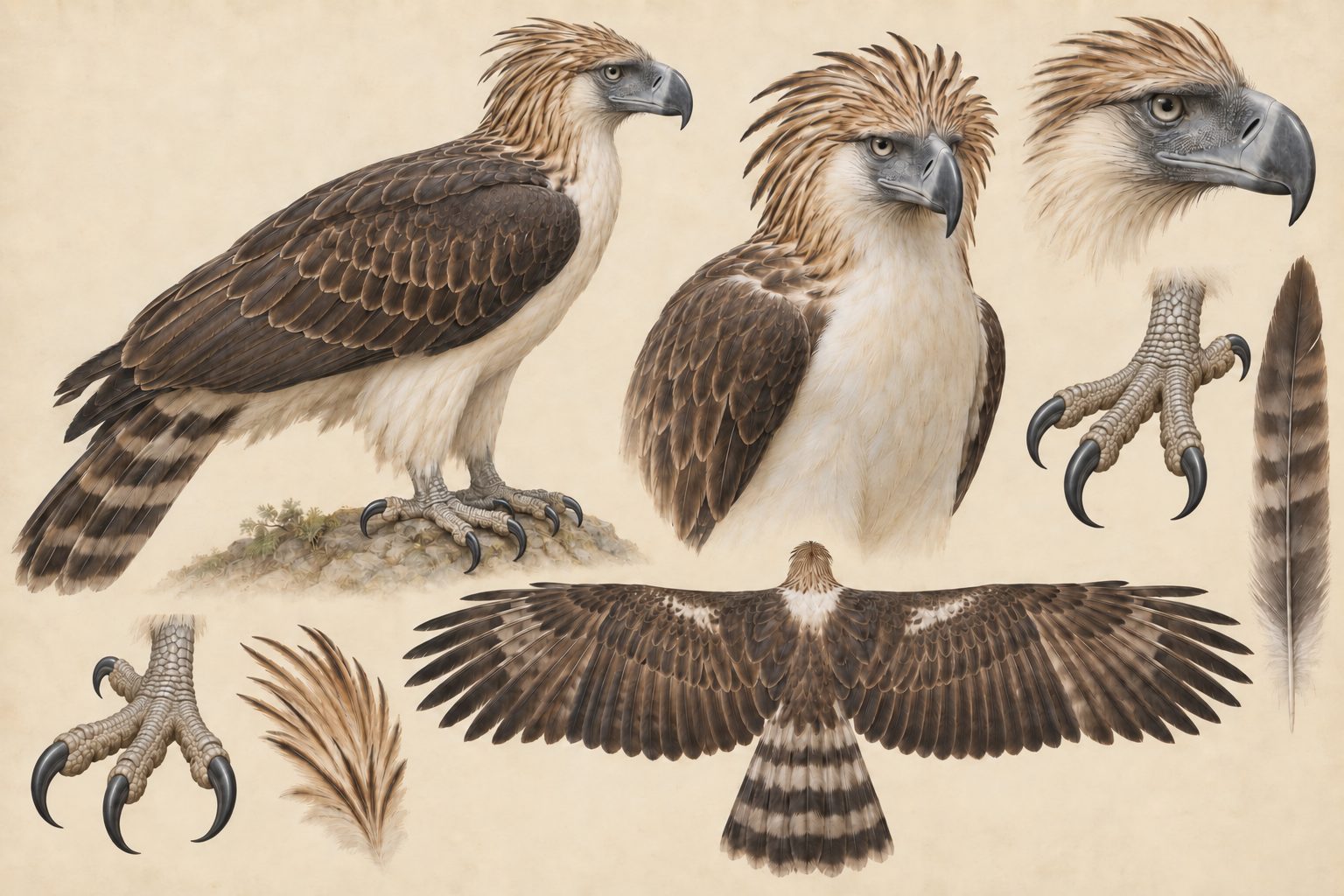
Interpretive museum study plate of a Philippine eagle showing its crest, massive bill, broad wings, and talons.
01Crest
02massive bill
03broad wings

Look for these structures in the turntable above. The form is an interpretation, not a claim about one wild individual.

Recovery systems · Philippine eagle

A nest is a forest commitment

Philippine eagle recovery begins at a nest tree and widens to a territory, a watershed, and the community relationships that keep mature forest standing.

The nest tree opens into a territory

A nest is the visible anchor of a much larger hunting, breeding, and watershed system.

  • Nest tree: Mature canopy and long-term pair site
  • Prey-rich forest: Hunting space around connected canopy
  • Watershed guardians: Community protection beyond the nest
Source: Bueser et al. · home range and habitat useMethod: Conceptual territory view; not a surveyed home-range map or nest location.

Recovery from nest to watershed

Protection is strongest when nest care, forest security, research, and community authority reinforce one another.

  1. 1
    Protect the nest

    Keep mature nest trees and the surrounding territory safe from disturbance.

  2. 2
    Keep forest standing

    Maintain prey-rich canopy, rivers, and connected habitat around the pair.

  3. 3
    Support guardians

    Work with community partners, field teams, and the Philippine Eagle Foundation.

  4. 4
    Return the record

    Share findings and credit decisions with the people who make the work possible.

Credit and consent record

  • Philippine Eagle Foundation · public programme source above
  • Community and Indigenous partner credits require confirmation and consent before publication.
Source: Philippine Eagle Foundation · conservation programmeMethod: Recovery workflow synthesis; it does not assign credit or consent on behalf of partners.

A canopy measured by attention

An optional listening prompt for a forest territory, with a readable record that keeps the exhibit useful without a sound file.

No audio recording is shipped with this plate. Read the transcript for the same scale-and-stewardship prompt.

Read transcript
  1. Field note: The canopy holds distance: water below, leaves above, and a pair moving through a large territory.
  2. Reading limit: No call, nest, or individual location is disclosed. The soundscape is a humane prompt for scale, not an encounter guide.
Source: Philippine Eagle Foundation · species and conservation programmeMethod: Interpretive listening script; no field recording, call identification, or location inference is implied.

Species dossier · visual reading

A nest tree is a whole forest commitment

A vertical profile that connects the Philippine eagle’s nest and hunting space to the communities and watershed that keep forest standing.

Watching ethicAn eagle’s territory is a living forest, not a scenic backdrop. Keep the nest tree, the community, and the wider watershed in the frame.

What to notice
  1. old-growth nest tree
  2. prey-rich canopy
  3. watershed guardianship
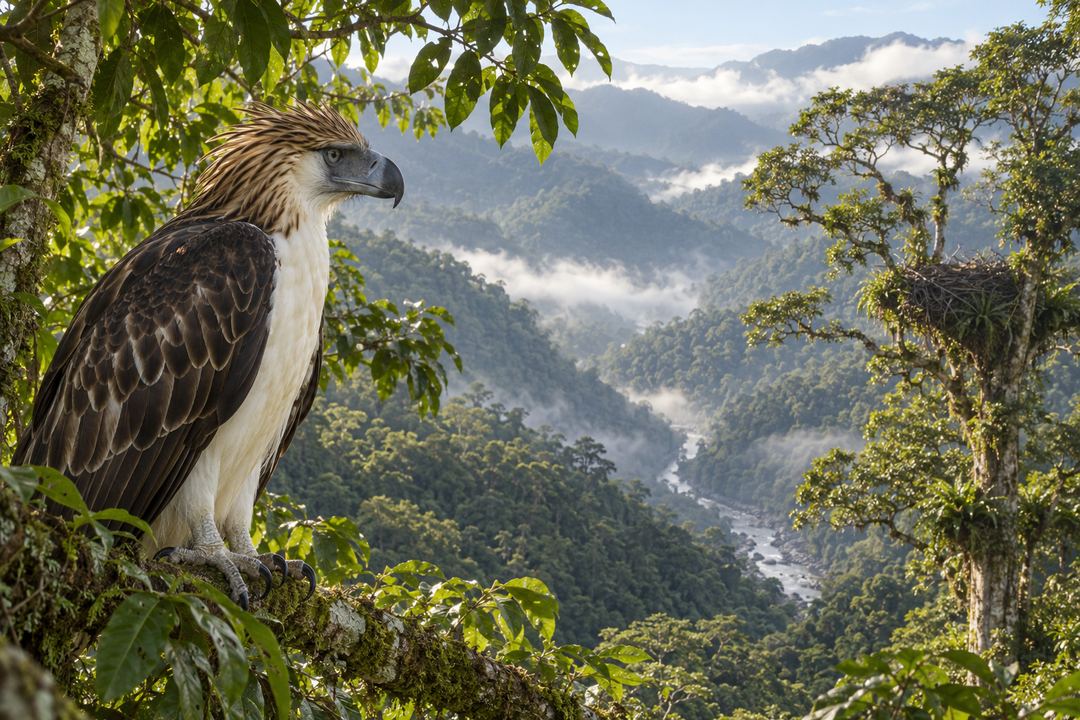
Interpretive field-observation plate of a Philippine eagle partly screened by Philippine rainforest canopy above a watershed.

Interpretive, not to scale. Pair the prompts with the existing turntable and source-linked field notes.

Natural history / field notes

The architecture of a forest

Philippine eagles use large forest territories with tall nesting trees and enough prey to support a slow reproductive cycle. Their scale makes fragmentation visible: a small island of trees can be too small to function as eagle habitat.

Protecting habitat therefore protects a whole vertical community, from canopy to forest floor.

One chick, a long investment

Pairs invest heavily in courtship, nest maintenance, incubation, and parental care. A slow life history means that adult survival and each successful breeding attempt carry exceptional weight.

This is why rescue, rehabilitation, and release are paired with habitat protection rather than treated as separate stories.

A breeding cycle with no spare parts

A slow breeding cycle gives every adult and every successful nest unusual weight. The eagle’s future is carried through long periods of care, not a quick burst of reproduction.

That rhythm changes the meaning of protection: keeping an adult alive, a nest tree standing, and a forest territory intact are connected parts of one intervention.

The watershed is part of the nest

A nest tree draws meaning from everything around it: prey-rich canopy, clean waterways, intact slopes, and community guardians who can keep pressure away. Forest protection is therefore a watershed practice as much as a wildlife practice.

When local stewardship has authority and continuity, the eagle’s territory gains a future larger than a single breeding attempt.


Behind the Render